Sunday, August 5, 2018

How to Modify a Crab Trap

When my friend, Captain Ralph MacDonald heard that I have an interest in capturing and eating the invasive green crabs he gave me a brand new crab trap and some fish carcases. Thank you Ralph! After inspecting it I quickly realized the spaces between the wires were too wide allowing these tiny crabs to escape. I expressed my idea of finding a material to make the holes smaller to my husband, so we visited our local Home Depot for steel hardware cloth. This post is a DIY on how to modify a store-purchased crab trap to capture the green crabs. You may have a better idea on how to alter the trap but this is what makes sense to me. When working with the wires be careful not to puncture your skin! I was very cautious but ended up pricking myself, fortunately just once with the tiny wire.

This will be my one and only medical or nursing comment about working with wires and harvesting marine animals--be sure your tetanus vaccine is up-to-date. Please have a conversation with your primary care provider if you are unsure. This is a food blog and I will try to answer only questions regarding green crabs, any crab questions I don't have the answer for I will do my best to find it. I will defer all medical and nursing questions to your primary care provider. If you do not have any please find one.

This trap took me several hours to make but it was also my first attempt at this. The whole process was not at all complicated. I basically cut out the panels and attached them to the exterior sides of my trap. The cutting took the most time because I was using a small wire cutter. I cut 2 1/2 to 3 inch length wire pieces (recycled from the wire that came wrapped around the mesh cloth) to secure the panels together. For the edges along the vertical sides of the pyramid I used a long nose pliers to wrap the new exterior sides to the original sides. I avoided wrapping any parts that were adjacent to the center square panel. All of the triangular panels must be able to move quickly and easily (flatten out when the entire trap is on the seafloor and back into a pyramid shape when pulling up on a string or rope). Any pieces of wire that were cut and sticking out I bent them with a long nose pliers to create a dull edge for safety reasons. I find that adding the new exterior sides on the outside of the original sides and wrap the wires inward is safer than having the pieces inside and wrapping out. If you modify your own trap you can decide what works best for you.

I use a soft mesh bag from a recycled clam bag, purchased at a seafood market, to store my bait and tie it to the center of the trap. I don't like waste so every time I return home I untie my bait bag and place the entire bag inside a plastic bag and store it in the freezer for the next crabbing trip. I use the same bait bag with the same bait. I would refresh it by adding 1-2 small new pieces of fish for each trip. On my first attempt I was able to pull up 101 green crabs in 2 hours. The second attempt I got 80 in an hour. The third time I pulled up a record of 103 crabs in an hour. The fourth time and most recent trip I went with scientist/researcher Dr. Bradt and pulled up 42 crabs in 45 minutes. Most of the crabs were roughly from 1 1/2 to 2 1/2 inches. The last batch I was able to get one that was 3/4 inch, the smallest from my trap.

modified crab trap


drop the trap in the water and secure the lines loosely to the dock
look closely and you will see the crabs crawling towards the bait
green crabs

How to Modify a Crab Trap

Supplies:

1 Eagle Claw Star Crab Trap
1 roll of 1/4 in. x 2 ft. x 5 ft. 23-Gauge Galvanized Steel Hardware Cloth
About 2 feet of wires
1 long nose pliers
1 wire cutter
A yardstick (optional)
A marker (optional)
Magnet (optional)

Instructions:

On a flat surface open up the trap and roll out the steel cloth.

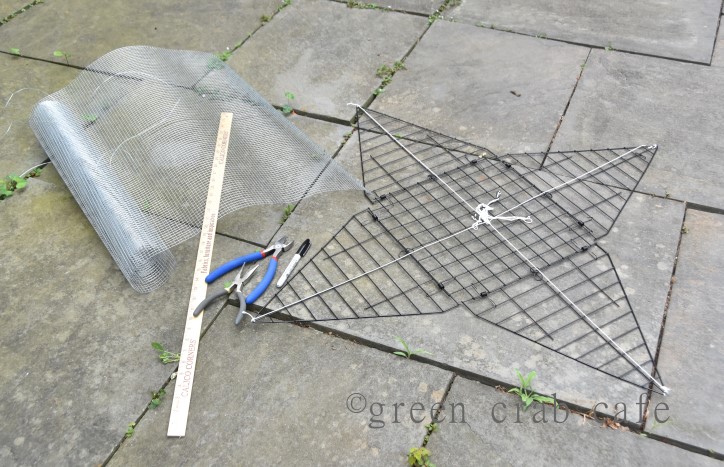
supplies
open  up the trap and roll out the steel cloth
Cut a square panel out of the cloth for the bottom (center piece) of the trap, leaving about 1/4 to 1/2- inch extra (on the cut sides) in order to bend the edges of those sides so the cut (sharp) pieces will not stick out and cause you present and future injury. It is always best to cut slightly larger than what you need and then fold in what you don't need. You may use a yardstick and a marker to mark the area (although you may end up putting some of the marker along the yardstick edge permanently) to guide you if needed. The yardstick is not necessary but it may help guide you.

cut out a square piece (for the bottom of the trap)
fold or bend the cut (sharp) edges with a long nose pliers
the bottom part is cut and the edges are not sharp to the touch
Cut the cloth into triangular shapes, again about 1/4 to 1/2-inch larger around the periphery than the original pieces. This way you can wrap the vertical sides along the original sides. For the top (tip) of the pyramid you do not want to close it up entirely. If you happen to do that (which I did) it is OK since you can always cut it out later. For some of the sides I cut the cloth in a straight line instead of following the angle of the triangle because it is quicker and easier. Wrap the edges of the vertical sides tightly along the original sides using a long nose pliers. Be sure that all the sharp edges are pressed tightly inward to prevent injury.

cut the pieces for the vertical sides
(try not to cover the tip of the opening,
if you do it is not a big deal, you can cut out the holes later)

use a long nose pliers and wrap the sides
of the exterior panel tightly to the original trap
fold or bend the cloth to wrap the interior original trap
Cut 2 1/2 to 3-inch wire pieces (may use the same wire that came already wrapping the cloth). Take a piece of wire and make a U shape and loop from the outside (of the trap) to inside the trap to secure the new exterior sides to the original sides. Take the long nose pliers and twist the wire piece to secure tightly. Bend any sharp edges underneath. Make sure nothing sharp is sticking out where it can cause you injury. Repeat this process on all sides of the trap to secure the panels.

cut the wire into 2 1/2 to 3-inch lengths
make a U shape with the cut wire pieces
loop the U shaped wire from the outside in to secure the 2 panels
use a long nose pliers to twist the wire a few times
the tie should look something like this
bend the sharp tips underneath to prevent any injury
Once all the exterior sides are completely secured to the original trap, look carefully for any sharp areas. Use the long nose pliers and bend any sharp pieces inward so they will not stick out and cause injury. Pick up any loose wire pieces from your work area and after the project is complete, properly discard them in the trash. You may use a magnet to help.

pick up any loose wire pieces and put in a container
may use a magnet to assist with this job
if you happen to cover up the triangular side while working on the trap
(see next photo below)
cut out a hole at the top (tip) of the pyramid trap
 in order to loop a rope or bungee cord through later
now the top (tip) of the pyramid trap has openings
for a rope or bungee cord to loop through
When you use your trap be sure to bring a long nose pliers and wire cutter with you in case you need to secure or fix it. Be sure to wash all of your supplies and trap with fresh water after using to prevent rust.

my typical crabbing supplies: a cooler, a bag with fresh water,
paper or cloth towels, extra bait, knife, scissors, long nose pliers,
wire cutter, small bungee cord, and bandaids

Saturday, August 4, 2018

Vietnamese Crab Noodle Soup (Bun Rieu)

I went to the dock with scientist/researcher, Dr. Bradt and showed her how my modified crab trap works. Luckily it functioned smoothly and I managed to pull up 42 crabs in less than an hour, ranging from 3/4 to 2 1/2 inches. The majority of the crabs were 1 1/2 to 2 1/2 inches. I came home and made this fairly large pot of Vietnamese crab noodle soup known in Vietnamese as bún riêu. This noodle soup is popular and is eaten all over Vietnam. In Vietnam the type of crab used for this special soup is the fresh water crab found in the rice paddies. They are similar in size to the green crabs found here in the Northeast United States. 

The stock or broth (riêu) used in this soup is made using a traditional Vietnamese method by hand crushing the crabs to a pulp. I find that adding a handful of crabs at a time in freezer bags (double bag) and using a heavy object to crush them gets the job done rapidly and helps for fast and easy cleanup later. After the crabs are crushed or pureed then add a little water to the contents, stir to lift out the crab meat and strain out the liquid and the fine meat bits. I repeat this process 3 times to get as much of the meat out as possible. Nowadays many people (in Vietnam) purchase the prepared crabs all ground up.

My mother makes her delicious bún riêu using lobster shells and rock crabs from Maine. Besides my mother and a few of her Vietnamese-American friends in Maine I know of very few others who make this noodle soup from scratch. I think most believe it is too time consuming...even I have had this misconception myself. After making this from scratch the most time consuming is the actual process of cleaning the crabs. I find that trapping and cooking them can be done quickly. 

We eat this bún riêu in a similar fashion as we eat other Vietnamese wet noodles such as the well-loved phở. A bowl is served along with a large platter of fresh herbs and vegetables and a little sauce on the side. A typical platter may consist of finely shredded banana blossom, finely shredded water spinach, bean sprouts, culantro, mint, perilla, Thai basil, Vietnamese mint or balm, lime cut in wedges, and hot chili peppers. If you do not have access to banana blossom or the water spinach then you may substitute them with finely shredded green or red cabbage. I like my bún riêu with a little fine shrimp sauce (fermented shrimp) but it is optional since not everyone likes this flavor. I think the fine shrimp sauce is a little similar to anchovies but much stronger in taste and smell. If you like anchovies then you probably can eat this sauce. When I sit down to eat my bowl of noodles with broth I add a lot of the vegetables from the plate to my bowl of noodles and broth, extra chilis (the hotter the better!), a little of the fine shrimp sauce, a drizzle of fish sauce if needed and a squeeze of lime or lemon juice, then mix it all up and slurp it down while it is piping hot!

My mission, although it may sound far fetched, is to make bún riêu using green crabs a known item in this area of New England! I hope that you will make this and encourage your family and friends to eat green crabs!

bún riêu
Vietnamese Crab Noodle Soup (Bún Riêu)

Ingredients:

Minimum 40-50 adult green crabs (preferably females)
12 cups cold water
3 Tbsp annatto oil (see recipe below)
2-3 large shallots, chopped (about 3/4 cup)
2 large garlic cloves, smashed, chopped (about 1 1/2 Tbsp)
2 scallions (green parts), chopped (about 1/2 cup)
About 1/2 cup uncooked green crab roe and crab mustard
6 peeled whole Roma (plum) tomatoes, quartered length-wise, cored
Fried tofu, 6-8 oz, slices
1 bunch of scallions (green parts only), cut into 1 1/2 to 2-inch lengths
2 tsp salt
1 1/2 Tbsp fish sauce (nước mắm)
3/4 to 1 oz rock sugar (đường phèn)
1 package of rice noodles (bún), cooked as directed on package
Fresh crab meat (optional)

Method:

Follow directions on how to make Vietnamese-Style Crab Stock, but use 12 cups of water to filter out the crushed crabs. Set the crab liquid aside in a large pot over a stove. Do not disturb (no stirring) the pot.

Heat a large pan over medium high heat, add annatto oil. Once hot add shallot, garlic and chopped scallion, saute about 1-2 minutes or until the shallot is soft. Add the roe/crab mustard and saute about a minute. Add tomatoes and tofu, saute about another minute to coat everything and remove from heat. Set aside.

Heat the pot with the crab liquid over medium high to high heat. Do not stir. Let the meat pieces float to the top undisturbed. Turn the heat down a little to avoid the liquid from boiling too hard or boiling over the pot. Skim off any white foam if interested. Once the pieces stop floating to the surface (about 5 minutes) add the sauteed contents to the pot. Stir gently once. Add the 2-inch cut scallions. Season with salt, fish sauce and sugar. Stir gently once more and turn heat to very low and serve hot.

Serve with rice noodles, platter of herbs and vegetables, fish sauce and fermented shrimp on the side.

sauteed shallot, garlic, scallion, roe/crab mustard,
tomatoes and tofu in annatto oil
cook the liquid and fine crab meat until the meat pieces float to the surface
Vietnamese crab noodle soup (bún riêu)
add cooked rice noodle to a large bowl
(there are small and large round rice noodles, purchase the smaller type)
pour the broth with tofu, tomatoes, and crab bits over it

add chilis, fermented shrimp, drizzle of fish sauce
and fresh herbs and vegetables
squeeze some lime
mix and enjoy
bún riêu without crab roe but has extra freshly picked rock crab meat on top
(made with my mother while in Maine) 


a platter with an assortment of fresh herbs/vegetables
(these are the more typical items served along with bún riêu)
may substitute green or red cabbage
for the banana blossom and water spinach

A Platter of Assortment of Fresh Herbs/Vegetables:

Finely shredded banana blossom (known as bắp chuối in Vietnamese)
Finely shredded water spinach (rau muống)
Bean sprouts (gía)
Mint (rau húng)
Thai basil (rau quế)
Green or purple perilla (also known as shiso in Japanese or rau tía tô in Vietnamese)
Culantro (rau ngò gai)
Vietnamese mint or balm (rau kinh giới)
Vietnamese coriander (rau răm)
Lime, cut in wedges (to squeeze a little into the soup if interested)
Hot chili peppers, chopped

Small Sauce Dishes:

A dollop of fine shrimp sauce (mắm ruốc or mắm tôm)
A small amount of fish sauce (nước mắm)

making annatto oil
How to Make Annatto Oil (makes 3 Tablespoons)

Ingredients:

3 1/2 Tbsp oil
1 Tbsp annatto seeds

Method:

In a pan add annatto seeds and oil. Stir the seeds over 1-2 minutes or until the oil turns bright orange-red. Remove the pan from heat and let the seeds steep for about 10-15 minutes. Strain and discard the seeds.

Helpful Hints:

*The total weight of 40 whole crabs for this recipe was about 2.75 pounds. After cleaning them and removing and discarding the carapaces, aprons, and gills and saving the roe in a separate dish the final prepared crab came to nearly 1.5 pounds. You may use more crabs if you have any. For the 12 cups of water this is the minimal amount of crabs that I would use. The crab flavor will decrease with less crabs. 
*My cousin (in Vietnam) known to me as Chế Xìa tells me she makes bún riêu similar way as this method on this post. However, she uses a blender to crush the crab (from the rice paddies) bodies, legs and claws without damaging her equipment.
*This soup should be enough for 4 fairly large bowls.
*The rock sugar can be found in an Asian market. Do not substitute rock sugar with equal amount of granulated sugar. If you do not have any rock sugar then use about 1 teaspoon of granulated sugar.
*As with all of the dishes on this blog, season your food according to yours and your family taste. My general rule of thumb is to season lightly when cooking and then adjust or add extra later for that individual person. If you add too much salt to start then it is quite difficult to remove it later.
*If you like to eat coagulated blood cubes in this soup like I do then you may add them when adding the sauteed contents to the pot at the end. You may purchase the blood in an Asian market. 
*The most expensive items for this soup especially living in New Hampshire would be the herbs and vegetables such as the banana blossom and water spinach. You may substitute with finely shredded red or green cabbage and a few types of easy to find herbs such as Thai basil, mint and cilantro.
*Peel and discard the outer layers (petals) of the banana blossom until you come to the tender tight part. Cut in half, core and slice as thinly as possible and immediately place in a container with cold water and juice from a lime or lemon (or may use about a tablespoon of vinegar). The acid will prevent the slices from turning black once the sap oxidizes with oxygen.
*You do not have to peel or deseed your tomatoes. The skin is a great source of fibers in your diet. However, if you choose to peel them then score the non-stem end of each tomato with a small X or +. Blanch them in boiling water for about 20 minutes or until they start to split down the side. Remove and peel once it is easy and safe (less hot) to handle. Cut into quarters (and core if interested). I prefer not to cook my tomatoes too long because I want to keep its shape in my soup.
*You can purchase the firm tofu, cut to bite size and fry in oil until golden or you can purchase them already fried in an Asian market. Add more tofu if you are interested. 
*The aquatic water spinach (rau muống) tastes nothing like the Western spinach. The flavor is very mild and it is eaten all over Southeast Asia. The Asian markets in the United States carry this vegetable but it is expensive especially in New England. For the bún riêu we use only the stalks. I use a peeler to finely shred then soak them in ice cold water to create beautiful curls. In Vietnam people generally use a vegetable peeler to create strands from these stalks. You may purchase a Water Spinach Splitter (from Amazon or an Asian market) but I find this tool to be a waste of money (I own one!). This tool has sharp blades arranged like wheel spokes intended to split the stalks. However, the stalks are too thick and I prefer using a vegetable peeler to do the same or better job.
*To cook the dried rice noodles: Place the noodles in boiling water and cook until soft. Test a strand for doneness by pinching it with your finger or eating one. Watch the pot while you boil the noodles so the liquid does not boil over the pot. Drain and run cold water over them to remove some of the starch and prevent the noodles from becoming clumpy.

thinly sliced banana blossom in cold water and lime juice
blanched tomatoes making them easy to peel
peeled, quartered, and cored tomatoes
shredded water spinach
shredded cabbage using a peeler
(this peeler was purchased in Tokyo, Japan)
you may use a spoon to remove and discard some of the liquid
from the roe and crab mustard before using
OR rinse the roe and crab mustard in cold water and strain out the water
(these last steps are not necessary)

Green Crab and Bean Omelet

Removing green crab meat is one task that can test your patience and attention! The freshly harvested beans and Chinese chives came from my parents' garden. If you use a non-stick pan you can fold or flip the omelet without the aid of a spatula for a free-form presentation. This omelet is mildly seasoned for my taste. However, as with any dishes that you make, season it according to yours and your family. I eat this with piping hot steamed rice.


green crab and bean omelet
Green Crab and Bean Omelet

Ingredients:

2 tsp oil
8 oz fresh beans, steamed for 5 minutes or until tender and chopped
4 oz freshly picked green crab meat (see How to Remove the Meat and Roe From a Cooked Crab link)
4 large eggs, whisked
1/4 tsp fish sauce (nước mắm)
1/8 tsp ground black or white pepper
2 sprigs of Chinese chives, chopped

Method:

Heat a non-stick pan with oil over medium high heat. Add beans and crab meat to the hot oil and saute about a minute or until the contents are heated through. Whisk eggs, fish sauce, pepper and chives. Pour the whisked egg mixture over the beans and crab meat. Cook about a minute and fold the omelet. Cook for about another minute or until the egg is not runny.

green crab meat
freshly harvested beans
saute the beans and crab meat
free-form omelet

How to Remove the Meat and Roe From a Cooked Crab

Is it worth removing meat from a green crab? According to my father it is equivalent to 'a tiger eating black flies', a direct translation from an old Vietnamese saying. Now you know my father's true opinion about eating green crab meat! All I can say is that if anyone dares to call or label me "lazy" I will have to challenge them to a green crab meat removal contest! Recently Dr. Bradt gave me some large green crabs that came from her university lab. These are the largest that I have seen, ranging from about 2 1/2 to 3 inches across the carapace. There are many ways to remove the meat. This post is a tutorial on how I generally remove meat from any type of crabs.

In order to remove the meat from the crabs the first thing is to clean them well with cold water. Discard any dead crabs. Either boil or steam them whole. Steaming takes a slightly longer time than boiling. Overcooking the crabs will cause the meat, roe and crab mustard to be too dry and less tasty. The crab mustard is the yellow-orange hepatopancreas (filtering organ found in lobsters and crabs). If you do not have time to remove the meat from all of your cooked crabs then once cooled, you may store them in a sealed container overnight in the refrigerator and process them the next day. Use a small knife with a pointy tip to remove the roe and/or crab mustard from the carapace and body. Use either your fingers or a small knife to separate the meat in between the cartilage from the body. I find that a small knife is an excellent tool to get between the cartilage and to scoop out the roe and crab mustard easily and quickly. Use a nut cracker to gently crush the claw to remove the meat. I prefer using a lobster/nut cracker (see my photo below). Save the unused parts for your garden compost if interested.

The freshly picked crab meat, roe and crab mustard may be kept a sealed in a glass or ceramic container in the refrigerator up to 2-3 days or sealed tightly in several plastic wraps and in a freezer bag for up to 3 months.

How to Remove the Meat, Roe and Crab Mustard From a Cooked Crab

1) Boil the crabs in water for about 5-7 minutes. These crabs are small so the cooking time will be short. They will turn red when cooked. Once cooked the meat can be removed easily.
2) Once cooled to handle remove the carapace. Scoop out the roe and crab mustard (the yellow- orange matter) from the carapace if there is any and save. Discard the carapace.
3) Gently pull the apron to remove the intestine and discard.
4) Remove the roe from the body if there is any and save.
5) Use a knife to cut the body into 4 sections. Remove the meat between the cartilage and save. Discard the gills, cartilage, shell bits and any non-edible parts.
6) Use a nut/lobster cracker to gently crack or break the shell of the claw and remove the meat. Discard any shell bits. Remove and discard the cartilage located inside the middle of the claw.
7) At the end look through the meat, remove and discard any shell or cartilage.

remove the carapace (top shell)
separated carapace and body
(the yellow-orange matter is the roe and/or crab mustard)
sweep inside the cave-like areas of the carapace (by the spines)
to remove all of the roe and/or crab mustard and save
remove the apron on the body and pull out the intestine and discard
remove the roe and/or crab mustard from the body and save
cut the body into 4 sections
cut bodies and claws
remove the meat between the cartilage of the body section
use a nut/lobster cracker to crack the shell of the claw
remove the shell
meat from the claw
remove and discard the cartilage located inside the middle of the claw
Is this 'a tiger eating black flies'??
picked cooked crab meat
picked cooked roe and crab mustard

Vietnamese Crab and Asparagus Soup (Sup Mang Cua)

Apparently Vietnamese crab and asparagus soup (súp măng cua) is a popular soup eaten on special occasions such as wedding banquets in Vietna...