Showing posts with label broth. Show all posts

Saturday, December 18, 2021

Basic Green Crab Stock

basic green crab stock

I have posted a few green crab stocks with ingredients besides green crabs and water. This particular basic stock is made with just 2 ingredients, green crabs and water. When I make my stock I avoid adding salt unless I plan on using it immediately. You can make any stock as concentrated as you prefer. If you make a concentrated stock then you will need less water, which to me means less storage space in the refrigerator or freezer. In general my green crabs to water ratio is about 15 crabs for 2-6 cups of water. These green crabs vary in size so my water will depend on this and how concentrate I prefer. Don't be afraid to experiment. Most of the time I clean the crabs, crush them and add water. I don't focus on any particular crab to water ratio and I hope you don't either. You may also check out these posts: How to Process Green Crabs Humanely, How to Prepare Green Crabs for Making Stock, Simple Green Crab Stock, and Green Crab Stock For Chowders.

Basic Green Crab Stock 

Ingredients:

Crabs
Water

Method:  

Remove the carapace, gills, apron and mouth from each crab. Wash well in cold to remove all the mud and sand. Crush the crabs, put them in a large pot and add water. Boil gently and stir occasionally for about 25-30 minutes. Strain right away or let it cool and strain. Before using may add more water if the stock is too concentrated for your taste. May compost the shells.


Butternut Squash and Green Crab Soup

butternut squash and green crab soup

It has been a long time since I posted anything on this blog. I am still working full-time as a family nurse practitioner at the clinic seeing patients. Despite the long hours I managed to stay healthy perhaps due to eating a copious amount of green crabs! 😃

Recently Dr. Becca Selden, from the Department of Biological Sciences at Wellesley College in Massachusetts invited me for a green crab cooking demo. I made 2 simple soups for the students and faculty to try. I was pleased and impressed to see so many students excited about eating green crabs! One of the soups was a butternut squash and green crab soup. I made it using coconut milk instead of dairy in case anyone was lactose intolerant. Luckily no one there had any food allergy or issues which made me very happy.

Butternut Squash and Green Crab Soup

Ingredients:
 
1 butternut squash (about 2 1/2 to 3 lbs)
Olive oil 
1 head of garlic
1 small white or yellow onion
3 1/2 to 4 C Basic Green Crab Stock (see recipe below)
1 C coconut milk
About 1/2 tsp salt to taste
About 1/2 tsp white or black pepper to taste
Coconut Drizzle (see recipe below) 

Method:

Peel and cut the butternut squash in half. Remove and discard the seeds. Slice the squash about 1/2 inch thick. Line in a single layer on a cookie sheet and drizzle with a little olive oil. Wrap the whole garlic in foil (may drizzle with oil if interested). Roast the squash and garlic in a preheated oven at 400 degrees F until the squash is fork tender, about 25-30 minutes. May broil for the last 5-10 minutes if interested. Peel and dice the onion. Saute the onion in a little olive oil until translucent and soft. Puree the roasted butternut squash, roasted garlic, sauteed onion, broth and coconut milk. Heat the pureed mixture until hot. Season with salt and pepper to taste. Whisk well to blend and serve hot with some coconut drizzle (see recipe below).


Coconut Drizzle

Ingredients:
 
Approximately 1 Tbsp of cornstarch 
Approximately 1 Tbsp water 
1/2 C coconut milk
Pinch of salt

Method: 

Mix the cornstarch and water until well blended. Cook this with coconut milk and salt. Whisk to blend. Drizzle over the butternut squash and green crab soup to garnish.


I have posted a few green crab stocks with ingredients besides green crabs and water. This particular basic stock is made with just 2 ingredients, green crabs and water. When I make my stock I avoid adding salt unless I plan on using it immediately. You can make any stock as concentrated as you prefer. If you make a concentrated stock then you will need less water, which to me means less storage space in the refrigerator or freezer. In general my green crabs to water ratio is about 15 crabs for 2-6 cups of water. These green crabs vary in size so my water will depend on this and how concentrate I prefer. Don't be afraid to experiment. Most of the time I clean the crabs, crush them and add water. I don't focus on any particular crab to water ratio and I hope you don't either. You may check out these posts: How to Process Green Crabs Humanely, How to Prepare Green Crabs for Making Stock, Simple Green Crab Stock, and Green Crab Stock For Chowders.

Basic Green Crab Stock 

Ingredients:

Crabs
Water

Method:  

Remove the carapace, gills, apron and mouth from each crab. Wash well in cold to remove all the mud and sand. Crush the crabs, put them in a large pot and add water. Boil gently and stir occasionally for about 25-30 minutes. Strain right away or let it cool and strain. Before using may add more water if the stock is too concentrated for your taste. May compost the shells.

Thursday, June 11, 2020

Basic Rehydrated Green Crab Stock

This basic green crab stock or broth is made from dried green crabs. Increase or decrease the ratio of ingredients to make more or less stock. You may add more crabs if you prefer a more concentrated broth. Before adding the dried crabs in the water you may crush them further using a mortar and pestle or a rolling pin to extract the most flavor out of them. This stock is very basic. You may add extra ingredients such as dried squid, dried shrimp, bonito flakes, animal or fish bones, seaweed, mushrooms, onion, scallions, ginger, cilantro stems/roots, carrots, parsnip, daikon, and celery for more flavors. I generally do not season my stock or broth as I will add it later in the final stage of cooking. My seasoning includes one or several of these ingredients; salt, fish sauce, soy sauce, fresh or dried beef, chicken, or mushroom stock. 

dried green crab stock
  
Basic Rehydrated Green Crab Stock

Ingredients:

2 cups of water
1/4 cup dried green crabs

Method:

Heat these two ingredients until the water comes to a boil. Turn heat down to a simmer for 20-25 minutes. Strain and discard the shells.

Tuesday, October 1, 2019

Seafood Risotto

I used a rice cooker to make the rice for this seafood risotto. This may not be the most traditional way to make it but my lazy way is fairly fast and tastes decent! In the past I have made my risotto by gradually adding a ladle of broth into the rice until the liquid was absorbed by the rice and then adding more until the rice is cooked al dente. This time I have no patience so I decided to use my rice cooker. This recipe makes about 6 servings. 

seafood risotto
Seafood Risotto

Ingredients:

2 C of arborio rice
3 to 3 1/2 C Green Crab Stock For Chowders
About 1 Tbsp oil (such as olive or vegetable oil)
1/2 white or yellow medium sized onion, chopped
5 baby bella mushrooms, thinly sliced
6 littleneck clams, scrubbed and washed
6 prepared female green crabs, leave the roe intact on the body, roe from carapace removed and set aside
12 large shrimp, peeled, butterflied, and deveined
12 sea scallops, tough muscles removed
5 squid, scored and cut into bite-size or cut into rings
About 10 squid tentacles
About 1/2 C frozen peas, microwaved for about 30-40 seconds, drained
5 chives plants, nipped with scissors or chopped
About 1 1/2 to 2 Tbsp fish sauce

Method:

Cook the rice with 2 1/2 cups of stock.

While the rice is cooking heat a large pan with oil over medium high heat. Add onion and cook until it is soft and translucent. Add mushrooms and cook until they are wilted. Add the clams and crabs, cook until the clams are partially opened, about 5 minutes. Add shrimp, scallops, squid, and squid tentacles. Cook until the shrimp are opaque and curled up (the scallops and squid will take less time). Scatter the roe and cook until they become solid. Stir in rice, peas, and another 1/2 to 1 cup of stock to moisten the rice. At the last 1-2 minutes add chives and season with fish sauce to taste.

Monday, September 30, 2019

Green Crab Stock For Chowders

green crab stock for chowders

Green Crab Stock For Chowders (makes about 4 1/2 cups)

Ingredients:

15 prepared green crabs
6 C water
3 young kelps (dried or fresh)
About 10 cilantro stems and 2 cilantro roots
1 small yellow or white onion, peeled, quartered or diced
3-4 slices of ginger, bruised
2 garlic cloves, smashed

Method:

Prepare each crab by removing and discarding the carapace, apron, and gills. Scrub the crabs in a little salt and rinse in cold water, let them drain. Crush the crabs (the finer the crabs are crushed the more flavors the result). Place the crab in a pot and add water, kelp, cilantro stems, cilantro roots, onion, ginger and garlic. Turn the heat to high. Once the liquid starts to boil turn the heat down to a simmer and cover the pot. Simmer for about 30 minutes. Strain and save the liquid for cooking.

Sunday, July 22, 2018

Vietnamese-Style Crab Stock

In Vietnam, rice paddy or rice-field crabs, known as "cua đồng" in Vietnamese exist in the rice paddies or rice fields. They are similar in size as the green crabs found here in the Northeast United States. My parents tell me they cause havoc by eating young rice shoots. I have not found any research that confirms that they actually ingest or simply just cut the young shoots while foraging. People have found a way to catch and eat them to near extinction just like most wildlife in Vietnam, according to my father. My cousins in Vietnam tell me that in recent years there are fewer of these once abundant crabs due to excessive use of pesticide. Although many people including my cousins in Vietnam buy these tiny crabs so they can make the classic Vietnamese crab noodle soup known as bún riêu, but are afraid to eat these freshwater crabs because of the potentially harmful chemicals used. Cousin Khiêm, an inspector for seafood in Vietnam, tells me that due to a demand for these crabs in central and northern parts of Vietnam, people have started to farm them in these regions. He has not seen or heard of anyone farming for them in the southern part of Vietnam. One of my aunts who resides in Los Angeles, California recently sent me a photo of imported frozen rice paddy crabs from Vietnam labeled as"cua đồng" sold in plastic bags in her local Asian markets.

rice paddy in Vietnam
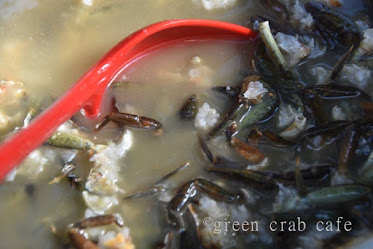
The stock or broth (riêu) is made using a traditional Vietnamese method by hand crushing the crabs to a pulp. Nowadays many people (in Vietnam) purchase the prepared crabs all ground up for convenience. You can use a blender to puree the crab bodies or you can hand pound the crab bodies, legs and claws. If you choose to use a blender you may want to avoid adding the legs and claws since these are tough and may damage your equipment. 
crush the prepared crabs with a heavy object on a stone
add a little water and stir well to help remove any crab bits
strain the liquid
repeat the process 2 more times or until the liquid is more clear

boil the broth until the fine crab meat floats to the surface in pieces
gently scoop and discard the white foam that floats to the surface

Vietnamese-Style Crab Stock

Ingredients:

Green crabs (see How to Prepare Hard-Shell Green Crab link)
Water

Method:

Prepare the crabs by removing and discarding the carapace, gills, and apron. Save the roe and/or crab mustard in a separate bowl to be used later. Discard the legs and claws if you prefer using only the bodies. Wash the prepared crabs with about 1 tablespoon of table salt. Rinse with cold fresh water 2-3 times to remove all the salt and drain off the water. Place the crabs in 1-2 freezer or heavy duty plastic bags and crush everything using either a hammer, stone or a heavy object against something hard such as a stone or brick. For best results add a handful of crabs at a time. Pour the crushed crabs in a pot or container. Repeat the process until all the crabs are crushed. Add a little water (about 1/3 of the total water you are using) to the crushed crabs and stir well to help remove the fine meat bits. Using a fine strainer, strain and filter out the crab meat and liquid. Add a little more water (about 1/2 of the remaining water you are using) to the crushed crabs and repeat the process until all the water is used up. By the 3rd and last time the water will become more clear with less crab bits. Save the strained fine crab bits and crab liquid for cooking. Discard the rest.

In a large pot add the crab bits and crab liquid, turn the heat to medium-high to high. Do not stir and let the broth comes to a gentle boil. Once it boils the fine crab meat will float to the surface in large pieces. Turn the heat down slightly if needed so the liquid does not boil over the pot. After about 4-5 minutes stir once and gently scoop out and discard the white foam (impurities) if interested. Avoid discarding the crab meat. Save the broth and crab pieces for making soups or stews.

Helpful Hints:

*1 pound of prepared green crabs can yield about 6-8 cups of broth. The less water you use will make your broth more concentrated and the more water will dilute your broth.
*The unused crab parts make great fertilizer for your garden. 
*My mother prefers to use only the green crab bodies when she makes this special stock. I use the bodies, legs and claws.

Zucchini Soup

zucchini soup

In Vietnam, rice paddy or rice-field crabs, known as "cua đồng" in Vietnamese exist in the rice paddies or rice fields. They are similar in size as the green crabs found here in the Northeast United States. My parents tell me they cause havoc by eating young rice shoots. I have not found any research that confirms that they actually ingest or simply just cut the young shoots while foraging. People have found a way to catch and eat them to near extinction just like most wildlife in Vietnam, according to my father. My cousins in Vietnam tell me that in recent years there are fewer of these once abundant crabs due to excessive use of pesticide. Although many people including my cousins in Vietnam buy these tiny crabs so they can make the classic Vietnamese crab noodle soup known as bún riêu, but are afraid to eat these freshwater crabs because of the potentially harmful chemicals used. Cousin Khiêm, an inspector for seafood in Vietnam, tells me that due to a demand for these crabs in central and northern parts of Vietnam, people have started to farm them in these regions. He has not seen or heard of anyone farming for them in the southern part of Vietnam. One of my aunts who resides in Los Angeles, California recently sent me a photo of imported frozen rice paddy crabs from Vietnam labeled as"cua đồng" sold in plastic bags in her local Asian markets.

The stock or broth used in this soup is made using a traditional Vietnamese method by hand crushing the crabs to a pulp. Nowadays many people (in Vietnam) purchase the prepared crabs all ground up for convenience. You can use a blender to puree the crab bodies or you can hand pound the crab bodies, legs and claws. If you choose to use a blender you may want to avoid adding the legs and claws since these are tough and may damage your equipment. 

crush the prepared crabs with a heavy object on a stone or hammer
filter out the fine crab meat with a little water and strain

boil the broth until the fine crab meat floats to the surface in pieces
gently remove the white foam
Vietnamese-Style Crab Stock

Ingredients:

Green crabs (see How to Prepare Hard-Shell Green Crabs link)
Water

Method:

Prepare the crabs by removing and discarding the carapace, gills, and apron. Save the roe and crab mustard in a separate bowl to be used later. Gently rub the bodies, claws and legs with about 1 tablespoon of salt. Rinse with fresh water 2-3 times to remove all the salt and drain off the water. Place the crabs in 1-2 freezer or heavy duty plastic bags and crush everything using either a hammer, stone or a heavy object against something hard such as a stone or brick. For best results add a handful of crabs at a time. Pour the crushed crabs in a pot or container. Repeat the process until all the crabs are crushed. Add a little water to the crushed crabs and stir well to help remove the fine meat bits. Using a fine strainer, strain and filter out the crab meat and liquid. Add a little more water to the crushed crabs and repeat the process 2 more times or until most of the crab meat is strained out (the water will become more clear with less crab bits). Save the strained fine crab bits and crab liquid for cooking. Discard the rest.

In a medium sized pot add the crab liquid, turn the heat to high. Do not stir and let the broth comes to a boil. Once it boils the fine crab meat will float to the surface in large pieces. Turn the heat down slightly if needed so the liquid does not boil over the pot. After about 4-5 minutes stir once and gently scoop out and discard the white foam (impurities) if interested. Avoid discarding the crab meat. Save the broth and crab pieces for making soups or stews.

Helpful Hints:

*I use 30 green crabs ranging from 1 1/2 to 2 1/2 inches to make 4 cups of broth for this soup.
*The unused crab parts make great fertilizer for your garden.


prep for soup
julienned zucchini and beans
zucchini flowers

Zucchini Soup

Ingredients:

4 cups of Vietnamese-style Crab Stock (see recipe above)
1 large garlic clove, smashed, peeled
2 large eggs, whisked and placed in a small seal-able sandwich bag
1 tsp oil
1 small shallot, peeled and chopped
2 beans, julienned
1 small zucchini, peeled and shredded or julienned
2 Tbsp chopped scallion
8 zucchini flowers, removed and discarded pistils, sliced
1/4 tsp sea salt (more or less depends on your taste)
1/4 tsp sugar
Fresh crab meat, optional
Freshly ground pepper

Method:

Heat a small pan and add oil. Once the oil is hot add shallot and saute about a minute or until the shallot is soft. Add peas and zucchini. Saute about 30 seconds and remove from heat.

In a medium sized pot add the Vietnamese-style Crab Stock and garlic, turn the heat to high. Do not stir and let the broth comes to a boil. Once it boils the fine crab meat will float to the top in large pieces. Turn the heat down slightly if needed so the liquid does not boil over the pot. After about 4-5 minutes stir once and gently scoop out and discard the white foam (impurities) if interested. Do not scoop out the crab meat that float to the top. Make a tiny cut about 1/8 inch on a corner of the sandwich bag (that has the whisked eggs). Stir the pot in one direction and let the whisked eggs pour out of the corner of the bag into the pot to create string-like texture.

After adding the eggs to the broth then add the sauteed contents, scallion, zucchini flowers and season with salt and salt. Turn off heat.

Serve the broth hot and garnish with fresh crab meat, black or white ground pepper and more zucchini flowers.

Helpful Hints:

*The freshly picked crab meat is Maine's peekytoe crabs. 
*If you like cilantro then garnish with a little chopped cilantro leaves. 
*Instead of salt you may season this soup with fish sauce.
Friday, June 22, 2018

How to Prepare Green Crabs for Making Stock

You can smash, crush or puree whole crabs, add water and make your stock or broth this way OR you can prepare the crabs the more tedious way like I do! Believe me, if I have a choice I prefer to do things the fastest and easiest way possible. It may sound time-consuming but I find that it is a better process to get the most out of my crabs. Part of my process is to clean the crabs by removing mud and sand, even though ingesting a little on occasion is not harmful to most people. The other essential part is the removal of the yellow-orange roe and/or crab mustard, if there is any. The crab mustard is the hepatopancreas, a filtering organ found in crabs and lobsters. These innards may sound toxic to ingest and probably are but for some people they are a delicacy. Eat with moderation if you are healthy and avoid if you are not.

My process of cleaning the hard-shell crabs for making stock is similar to preparing the soft-shell ones. The difference is removing the entire carapace in order to get to the yellow-orange matter and keeping the pointy legs intact. The hard-shell crabs are much stronger and faster than the soft-shell ones so you need to work a little faster and apply some pressure when removing the carapace. I remove these parts with my fingers but you can use scissors with pointy tips--carapace (dorsal shell), the gills on each side of the body, and the V-shaped apron on the abdomen. Scoop out the yellow-orange innards and reserve it in a separate bowl. For me, the best way to remove the most of this innards is to use a pointy flat knife. They are found in the interior of the carapace and on the middle of the body just underneath the carapace. Once these tasks are complete, rub the crabs with a little salt, rinse the prepared crabs in cold water, strain and place them in a clean bowl or pot to be used. Save the scooped out roe and crab mustard and keep them refrigerated until ready to use.

green crabs
lift up with one thumb just under one side of the carapace while
holding onto the belly with the other hand and push
with that thumb (while applying some pressure)
to separate the entire carapace
separating the carapace from its body
carapace and crab body
pull out the gills on each side of the body and discard
ventral view (belly side)--mouth parts, apron, pointy legs
pry open the apron with the tip of scissors or knife,
pull off the apron and discard
remove the roe and crab mustard found on the middle of the body and save
remove the roe and crab mustard from the interior of the carapace and save
prepared crabs with roe and crab mustard
may rinse and strain crab roe and crab mustard if interested

Helpful Hints:

*If you are planning on crushing the crabs then you may keep the point legs intact to save time. Removing them makes no difference in your stock.
*In my family we clean the prepared seafood with a salt rub (about 2 teaspoons to 1 tablespoon) and then wash with cold water several times to rinse off the salt. You can also do the same by using vinegar (about 2-3 tablespoons) to wash then rinse with cold water immediately. Do not allow the seafood to soak in the salt or vinegar.
*When preparing the crabs you may want to wear gloves to prevent injury. I find that wearing 2 layers of the exam gloves to be most helpful when cleaning the crabs. You may purchase these exam gloves at your local pharmacy store or online.

Vietnamese Crab and Asparagus Soup (Sup Mang Cua)

Apparently Vietnamese crab and asparagus soup (súp măng cua) is a popular soup eaten on special occasions such as wedding banquets in Vietna...